Finalize my selection 0

You have not selected a product

View from the driver's seat of a semi truck on the highway driving toward the sunset

View from the driver's seat of a truck of the highway

View from the driver's seat of a truck of the highway and a landscape of fields at dawn.

Trucking Regulations: What Fleet Operators Need to Know
Published on November 11, 2024 - 5 minute read

Updated November 2026

Trucking regulations continue to evolve, bringing changes that affect how commercial fleets operate, maintain compliance, and manage costs. From driver qualifications and safety requirements to emissions standards, staying informed is an important part of running a successful trucking operation.

Several regulatory developments in 2025 and 2026 have changed the compliance landscape for fleet managers and owner-operators. Some requirements have taken effect, while other proposals have been withdrawn or remain under consideration.

Understanding which regulations apply to your fleet, what's changed, and what steps you may need to take can help you avoid compliance issues and keep your operations running efficiently.

Let's look at the key trucking industry regulations and updates fleet managers should know in 2026.


What Trucking Regulations Should Fleet Managers Know About in 2026?

Update on Automatic Emergency Braking on Commercial Trucks

Overview: Automatic Emergency Braking (AEB) systems use sensors to detect potential collisions and automatically apply the brakes when necessary. The technology is designed to help prevent crashes or reduce their severity.

The Federal Motor Carrier Safety Administration (FMCSA) and National Highway Traffic Safety Administration (NHTSA) have been developing federal AEB requirements for certain heavy commercial vehicles. A proposed rule was published in 2023, and the agencies are continuing work on revised requirements.

As of November 2026, the heavy-vehicle AEB rule has not been finalized. Fleet operators are not currently subject to a new federal AEB mandate under this proposal.

Cost Implications for Small Fleets: If new requirements are finalized, fleets may need to consider AEB availability and equipment costs when purchasing vehicles. The financial impact will depend on the final requirements, vehicle specifications, and manufacturer pricing.

How to Prepare:

  •     •  Evaluate New Vehicles: Ask manufacturers about available AEB systems when purchasing or replacing trucks.

  •     •  Train Drivers: Help drivers understand how AEB works, its limitations, and why attentive driving remains essential.

  •     •  Monitor Regulatory Updates: Follow FMCSA and NHTSA announcements for finalized requirements and compliance timelines.

  •  

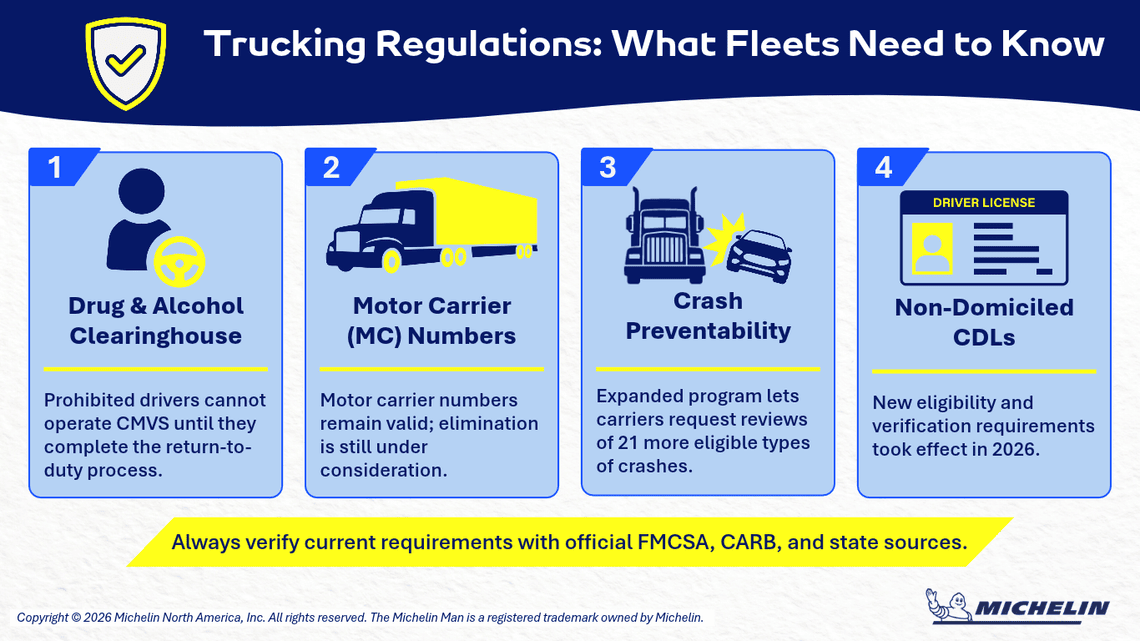
Michelin infographic highlighting four trucking regulatory topics: Drug and Alcohol Clearinghouse compliance, motor carrier numbers, crash preventability reviews, and non-domiciled commercial driver's licenses.

Trucking Regulations: What Fleets Need to Know

Michelin infographic summarizing four key trucking regulatory topics for fleet managers and owner-operators in 2026. Covers Drug and Alcohol Clearinghouse requirements, the status of motor carrier (MC) number elimination, expanded Crash Preventability Determination Program eligibility, and updated non-domiciled CDL requirements. Encourages fleets to verify current regulations through official FMCSA, CARB, and state resources.
 

Are Speed Limiters Required on Commercial Trucks?

Overview: In July 2025, the Federal Motor Carrier Safety Administration (FMCSA) and National Highway Traffic Safety Administration (NHTSA) officially withdrew their proposed federal speed limiter requirements for heavy commercial trucks.

The proposal would have required certain trucks weighing more than 26,000 pounds to use electronic speed-limiting devices. However, the agencies cited safety concerns, policy considerations, and insufficient data when deciding not to move forward.

As of November 2026, there is no federal mandate requiring commercial trucks to install or use speed limiters under this withdrawn proposal. Fleets must still follow applicable posted speed limits and state regulations.

What This Means for Small Fleets: Fleet operators are not required to invest in speed limiter technology as a result of the withdrawn proposal. However, some fleets may choose to use speed management technology as part of their safety and operational policies.

How to Prepare: Continue monitoring FMCSA regulatory updates and review existing fleet speed management policies to support safe driving practices.


Can Fleet Managers Challenge Crashes They Couldn't Prevent?

Overview: The Federal Motor Carrier Safety Administration (FMCSA) expanded its Crash Preventability Determination Program (CPDP) on December 1, 2024, allowing motor carriers and drivers to request reviews of additional crash types they believe were not preventable.

The program now covers 21 eligible crash types, including four new categories:

  •     •  A commercial motor vehicle (CMV) struck on the side by another vehicle traveling in the same direction.

  •     •  A CMV struck by a vehicle entering the roadway from a private driveway or parking lot.

  •     •  A CMV struck because another motorist lost control of their vehicle.

  •     •  Other eligible crashes where video evidence demonstrates the sequence of events.

Why It Matters for Fleets: When FMCSA determines that a crash was not preventable, it is excluded from the carrier's Crash Indicator BASIC calculation within the Safety Measurement System (SMS). The crash remains visible in the system with its determination noted.

This gives fleets an opportunity to ensure certain crashes outside their control are more accurately reflected in federal safety performance data.

How to Submit a Crash for Review:

  •     1  Review Eligibility: Check whether the crash qualifies under one of FMCSA's 21 eligible categories.
  •     2  Gather Documentation: Collect the required police accident report and supporting evidence, such as photographs, video footage, or other relevant records.
  •     3  Submit Through DataQs: File a Request for Data Review (RDR) through FMCSA's DataQs system.
  •     4  Monitor the Review: Track the request and respond to any requests for additional documentation.

What This Means for Small Fleets: Maintaining organized crash records and preserving available evidence can help fleet operators take advantage of the program when eligible incidents occur. Although the program does not guarantee reduced insurance costs, it can help ensure qualifying non-preventable crashes do not negatively affect the carrier's Crash Indicator BASIC calculation.


How Does the Drug and Alcohol Clearinghouse Affect CDL Compliance?

Overview: Since November 18, 2024, the Federal Motor Carrier Safety Administration's (FMCSA) Drug and Alcohol Clearinghouse II rule has required State Driver Licensing Agencies to remove commercial driving privileges from drivers with a "prohibited" status in the Clearinghouse.

Drivers with this status cannot legally operate a commercial motor vehicle (CMV) until they complete the required return-to-duty process. States must also check Clearinghouse records before issuing, renewing, upgrading, or transferring commercial driver's licenses (CDLs).

What This Means for Small Fleets: Employers must continue conducting required Clearinghouse queries before allowing newly hired drivers to operate commercial vehicles and at least annually for existing drivers. Failure to identify a prohibited driver can create compliance risks and disrupt fleet operations.

How to Stay Compliant:

  •     •  Conduct Required Queries: Complete pre-employment and annual Clearinghouse checks for applicable CDL drivers.

  •     •  Monitor Driver Eligibility: Ensure drivers with a prohibited status are not assigned to safety-sensitive driving duties.

  •     •  Maintain Accurate Records: Keep required documentation of queries, testing, and compliance activities.

  •     •  Understand Return-to-Duty Requirements: Ensure affected drivers complete the required process before resuming safety-sensitive duties.

  •  

Are MC Numbers Being Eliminated for Motor Carriers?

Overview: The Federal Motor Carrier Safety Administration (FMCSA) is modernizing its registration process through Motus, a new USDOT registration system designed to simplify registration, improve data accuracy, and strengthen protections against fraud.

Although FMCSA previously planned to phase out Motor Carrier (MC) numbers, that change has not been implemented. As of November 2026, existing MC numbers remain valid, and their elimination is still under consideration.

Under the proposed approach, USDOT numbers would become the primary identifiers for registered entities, with additional suffixes identifying specific types of operating authority.

What This Means for Small Fleets: Carriers do not currently need to replace their existing MC numbers or update business records solely because of the proposed elimination. However, they should stay informed about FMCSA's registration modernization efforts and any future changes to identification requirements.

How to Prepare:

  •     •  Keep Registration Information Current: Review your company's USDOT and operating authority information for accuracy.

  •     •  Understand the New System: Familiarize yourself with FMCSA's Motus registration platform and its verification requirements.

  •     •  Monitor Future Announcements: Watch for official rulemaking and implementation timelines before making changes to existing MC number records.

  •  

What Is the Current Status of California's Advanced Clean Fleets Regulation?

Overview: California's Advanced Clean Fleets (ACF) regulation was originally designed to accelerate the adoption of zero-emission medium- and heavy-duty vehicles. However, the regulation has undergone significant changes since its introduction.

In January 2025, the California Air Resources Board (CARB) withdrew its request for federal authorization to enforce certain ACF requirements. California subsequently adopted amendments removing requirements affecting private and federal fleets, including drayage operations. Requirements for state and local government fleets remain in place.

What This Means for Small Fleets: Private fleet operators should not assume the original ACF purchase deadlines still apply. However, California maintains other vehicle emissions requirements that may affect commercial operations, depending on vehicle type and location.

How to Stay Informed:

  •     •  Review Applicable Requirements: Confirm which California emissions regulations apply to your fleet and vehicles.

  •     •  Evaluate Long-Term Equipment Needs: Consider vehicle replacement cycles, operating costs, and infrastructure when assessing alternative-fuel or zero-emission vehicles.

  •     •  Monitor CARB Updates: Follow official announcements for changes to emissions standards and fleet requirements.

  •  

What Changed for Non-Domiciled Commercial Driver's Licenses in 2026?

Overview: In March 2026, FMCSA implemented stricter eligibility and verification requirements for non-domiciled commercial driver's licenses (CDLs).

The updated rule limits eligibility for foreign-domiciled applicants to certain qualifying employment-based immigration statuses and strengthens documentation and verification requirements.

What This Means for Small Fleets: Carriers employing drivers with non-domiciled CDLs may need to pay closer attention to license validity and renewal eligibility. Changes in a driver's licensing status could affect staffing and scheduling.

How to Stay Compliant:

  •     •  Verify Driver Qualifications: Confirm that drivers hold valid CDLs appropriate for their assigned vehicles.

  •     •  Monitor License Expiration Dates: Track renewals and identify potential eligibility issues before they disrupt operations.

  •     •  Stay Informed: Follow FMCSA guidance and state licensing agency updates regarding non-domiciled CDL requirements.

  •  

How Can Fleet Operators Stay Ahead of Changing Trucking Regulations?

Trucking regulations continue to evolve, and staying compliant requires more than reacting to new requirements. For fleet managers and owner-operators, understanding which rules are currently enforceable, which have changed, and which remain proposals is essential to avoiding unnecessary costs and operational disruptions.

A few proactive steps can help:

  •     •  Monitor Official Sources: Follow FMCSA, USDOT, and applicable state agencies for regulatory updates.

  •     •  Review Compliance Procedures: Regularly evaluate driver qualifications, safety records, vehicle requirements, and documentation.

  •     •  Plan Ahead: Consider how regulatory changes could affect staffing, equipment purchases, maintenance schedules, and operating budgets.

  •     •  Prioritize Fleet Readiness: Maintain a consistent preventive maintenance program to support vehicle safety, reliability, and regulatory compliance.

At Michelin, we understand that keeping your fleet moving means balancing safety, compliance, and operating costs. The right tire strategy and preventive maintenance practices can help support reliable operations as industry requirements continue to change.

Explore Michelin's commercial tire solutions and fleet resources to help keep your business moving forward.


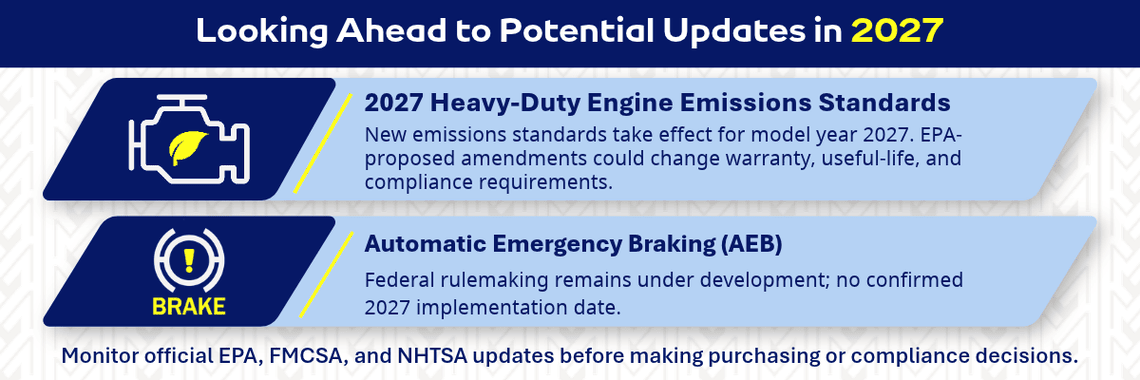
Infographic highlighting potential 2027 trucking regulatory updates, including heavy-duty engine emissions standards and automatic emergency braking requirements.

Looking Ahead to 2027: Potential Trucking Regulation Updates

Michelin infographic outlining two important regulatory developments for commercial fleets heading into 2027. Covers upcoming heavy-duty engine emissions standards, proposed EPA amendments, and the status of federal automatic emergency braking rulemaking. Encourages fleet operators to monitor official EPA, FMCSA, and NHTSA updates to stay informed and prepare for potential compliance changes.


Looking Ahead to 2027: What Trucking Regulations Should Fleets Watch?

As fleet operators plan for 2027, two regulatory developments are worth monitoring:

2027 Heavy-Duty Engine Emissions Standards: New federal emissions standards for heavy-duty engines are scheduled to take effect beginning with model year 2027. The EPA has also proposed changes to certain compliance requirements, including engine warranty periods and regulatory useful life. Fleet operators considering new truck purchases should monitor these developments and discuss potential implications with equipment suppliers.

Automatic Emergency Braking (AEB): Federal regulators continue to evaluate requirements for automatic emergency braking systems on heavy trucks. While the rulemaking remains under development, fleets can begin evaluating available safety technologies when planning future vehicle purchases.

Because regulatory timelines and requirements can change, fleet managers should consult official EPA, FMCSA, and NHTSA updates before making purchasing or compliance decisions.

You are using and outdated Web Browser.

You are using a browser that is not supported by this website. This means that some functionality may not work as intended. This may result in strange behaviors when browsing round.

Use or upgrade/install one of the following browsers to take full advantage of this website

Firefox 78+
Edge 18+
Chrome 72+
Safari 12+
Opera 71+