
Semi truck parking is a growing issue as there is a shortage
The long-distance truck driver lifestyle, showing a driver resting at a truck stop with a big rig parked nearby
Updated November 2026
The trucking industry keeps the economy moving, yet one of the biggest roadblocks facing drivers isn't just traffic. It's finding a safe place to park.
According to the American Transportation Research Institute's (ATRI) 2026 Critical Issues in the Trucking Industry report, truck parking ranked as the second-highest concern among professional truck drivers. The ongoing shortage of available parking creates challenges that extend beyond inconvenience, affecting driver safety, Hours-of-Service (HOS) compliance and fleet efficiency.
For fleet managers, time spent searching for parking can mean lost productivity, increased operating costs and added pressure on drivers trying to meet delivery schedules.
With new federal investments aimed at expanding truck parking availability, efforts to address the shortage are underway. But for drivers and fleets navigating the challenge today, planning and access to reliable parking information remain essential.
Let's look at what's driving the truck parking shortage, how it affects fleet operations and what can be done to help drivers find safe places to park.
ON THIS PAGE
• Why Is Truck Parking Such a Big Problem?
• How Does the Truck Parking Shortage Affect Fleet Managers?
• What's Being Done to Address the Truck Parking Shortage?
• What Can Fleet Managers Do to Help Drivers Find Safe Truck Parking?
• Final Thoughts: Addressing the Truck Parking Shortage
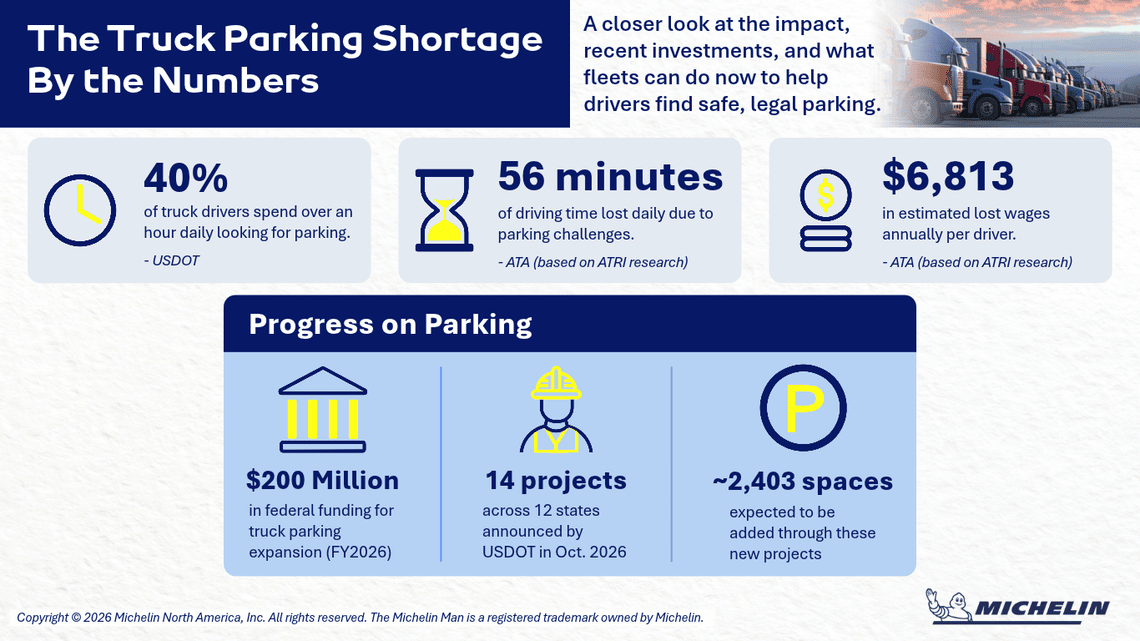
Truck Parking Shortage: Key Statistics and 2026 Investments
Michelin infographic illustrating the impact of the U.S. truck parking shortage on commercial truck drivers and fleet operations. Highlights include 40% of drivers spending over an hour searching for parking daily, 56 minutes of lost driving time, and an estimated $6,813 in annual lost wages per driver. Also features $200 million in FY2026 federal funding supporting 14 projects across 12 states, with approximately 2,403 additional parking spaces expected.
Why Is Truck Parking Such a Big Problem?
Truck parking shortages have challenged the trucking industry for years. While public investment in additional parking capacity is increasing, drivers still face limited options along major freight corridors, near distribution centers, and in urban areas.
1. Not Enough Parking Spaces Where Drivers Need Them
Truck parking availability varies by location, time of day, and freight corridor. Even when parking facilities exist, spaces may be full when drivers need to stop.
This can force drivers to spend additional time searching for parking, travel farther from their routes, or adjust delivery schedules to find a safe, legal place to rest.
2. Hours-of-Service (HOS) Requirements
Federal Hours-of-Service regulations limit how long commercial truck drivers can drive before taking required breaks and rest periods. Finding available parking within those limits can be challenging, particularly along busy highways.
When designated parking areas are full, drivers may face difficult decisions about where to stop. Parking on highway shoulders, entrance ramps, or other unauthorized areas can create serious safety risks.
3. Urban and Last-Mile Delivery Challenges
Parking can be especially difficult in urban areas, where space is limited and local regulations may restrict commercial vehicle parking.
For fleets operating near warehouses, distribution centers, and delivery destinations, limited parking and staging areas can lead to additional miles, delays, and scheduling challenges.
Planning routes around available parking and designated loading areas can help fleets reduce these disruptions.
How Does the Truck Parking Shortage Affect Fleet Managers?
Truck parking shortages don't just affect drivers. They create operational challenges for fleet managers, from lost productivity and increased costs to safety concerns and driver frustration.
1. Lost Productivity and Increased Operating Costs
Searching for available parking takes valuable time away from moving freight. According to the U.S. Department of Transportation, 40% of truck drivers spend more than an hour each day looking for parking.
The financial impact adds up. The American Trucking Associations (ATA) reported in 2026 that drivers lose an average of 56 minutes of driving time daily due to parking challenges, contributing to an estimated $6,813 in lost wages annually per driver, based on earlier ATRI research.
For fleet managers, those lost driving hours can also mean reduced productivity, additional fuel expenses and more complicated delivery schedules.
2. Increased Safety Risks
When designated parking areas are full, drivers may resort to stopping on highway shoulders, entrance ramps or other unauthorized locations. These situations can increase the risk of collisions and create additional safety and compliance concerns for fleets.
Helping drivers identify safe, legal parking options before reaching their Hours-of-Service (HOS) limits can reduce the pressure to make last-minute decisions.
3. Driver Satisfaction and Retention
Finding safe parking at the end of a long shift shouldn't add to a driver's stress. Yet limited availability can make it difficult to plan rest breaks, manage driving hours and get adequate rest.
For fleet managers, providing reliable parking information, realistic schedules and support when parking plans change can help reduce driver frustration and improve the overall driver experience. Over time, that support can also contribute to driver satisfaction and retention.
What's Being Done to Address the Truck Parking Shortage?
Addressing the truck parking shortage requires more than adding spaces. Federal and state investments, parking technology, and private-sector initiatives are all helping expand access to safe, legal parking for commercial drivers.
1. Federal and State Investments in Truck Parking
Federal funding for truck parking has taken a significant step forward in 2026.
In February 2026, Congress approved $200 million in dedicated funding for truck parking expansion through the fiscal year 2026 appropriations legislation. This marked the first time Congress approved funding specifically reserved for expanding commercial truck parking.
In October 2026, the U.S. Department of Transportation (USDOT) announced $200 million in investments supporting 14 truck parking projects across 12 states. According to USDOT project estimates, these improvements are expected to add approximately 2,403 parking spaces along important freight corridors.
Examples include:
-
• Tennessee: Approximately 500 new truck parking spaces along the I-40 and I-24 freight corridors.
-
• Georgia: Approximately 275 spaces near the Port of Savannah.
-
• North Carolina: Approximately 140 truck parking spaces at the Port of Wilmington.
-
• Texas: Approximately 305 spaces near the Los Indios Port of Entry.
These investments represent progress, but the projects will take time to complete. Drivers and fleet managers will still need to plan around existing parking limitations as new capacity becomes available.
2. Technology Solutions for Drivers and Fleet Managers
While infrastructure investments address long-term parking capacity, technology can help drivers navigate the shortage today.
Truck parking apps and reservation platforms can help drivers identify parking locations, review available amenities, and reserve spaces where supported. For example, Trucker Path provides truck parking locations and driver-reported availability, while Truck Parking Club allows drivers to search for and reserve spaces at participating facilities.
Fleet managers can also use GPS tracking, route planning, and fleet management technology to account for parking needs when scheduling deliveries and required rest periods.
Michelin Connected Fleet provides fleet visibility and vehicle location information that can support route planning and help managers make more informed operational decisions.
Combining these tools with driver communication and realistic schedules can reduce last-minute parking searches and help fleets plan more efficiently.
3. Private-Sector Investments and Parking Partnerships
Truck stops, logistics facilities, and private parking operators also play a role in expanding available parking options.
Some facilities offer paid or reserved truck parking, giving drivers an opportunity to secure a space before reaching the end of their driving hours. Fleets may also explore arrangements with parking providers or logistics partners to establish more predictable parking options along frequently traveled routes.
For fleet managers, these arrangements can be particularly useful on routes where public parking is limited or demand is consistently high.
Although no single solution will eliminate the shortage, continued investment and better access to parking information can help make safe truck parking more accessible.
What Can Fleet Managers Do to Help Drivers Find Safe Truck Parking?
While new truck parking infrastructure is being developed, fleet managers can take steps today to help drivers find safe, legal parking and reduce unnecessary delays.
1. Plan Parking Stops Alongside Delivery Routes
Build parking stops into route planning rather than leaving drivers to find available spaces at the end of their shifts.
Consider designated truck stops, rest areas, and other legal parking locations along each route. Identify backup options in case preferred locations are full, and account for required Hours-of-Service (HOS) breaks when setting delivery schedules.
2. Use Fleet Technology to Support Better Planning
Fleet management technology can help dispatchers monitor vehicle locations, track progress along routes, and make adjustments when delays occur.
Michelin Connected Fleet provides vehicle tracking and fleet visibility tools that can support route planning and communication between drivers and dispatchers.
Dedicated truck parking apps and reservation platforms can complement these tools by helping drivers locate available parking and reserve spaces where that option is offered.
3. Give Drivers Flexibility and Support
Even well-planned routes can change because of traffic, weather, delivery delays, or limited parking availability.
Encourage drivers to communicate parking concerns early, particularly when they're approaching their driving-hour limits. Dispatchers should be prepared to adjust schedules or help identify alternative parking locations when needed.
Providing realistic delivery expectations and supporting drivers when parking plans change can help reduce stress and avoid unnecessary safety risks.
4. Consider Reserved Parking on High-Demand Routes
For routes where parking is consistently difficult to find, explore reserved parking options or partnerships with truck stops and private parking providers.
Although these services may involve additional costs, they can offer greater predictability for drivers and help reduce time spent searching for available spaces.
Keeping Drivers Safe and Fleets Moving
Truck parking remains a significant challenge for the trucking industry, affecting driver safety, productivity, and fleet operating costs.
Federal investments announced in 2026 represent an important step toward expanding parking availability, but new infrastructure will take time to become available.
In the meantime, fleet managers can make a difference through better route planning, reliable parking information, and stronger communication with drivers.
Finding a safe place to park shouldn't be an afterthought. Making it part of everyday fleet planning can help protect drivers, reduce unnecessary delays, and keep operations running more efficiently.


