Tractor and implement with CTIS
Central Tire Inflation System (CTIS) for Farming Equipment
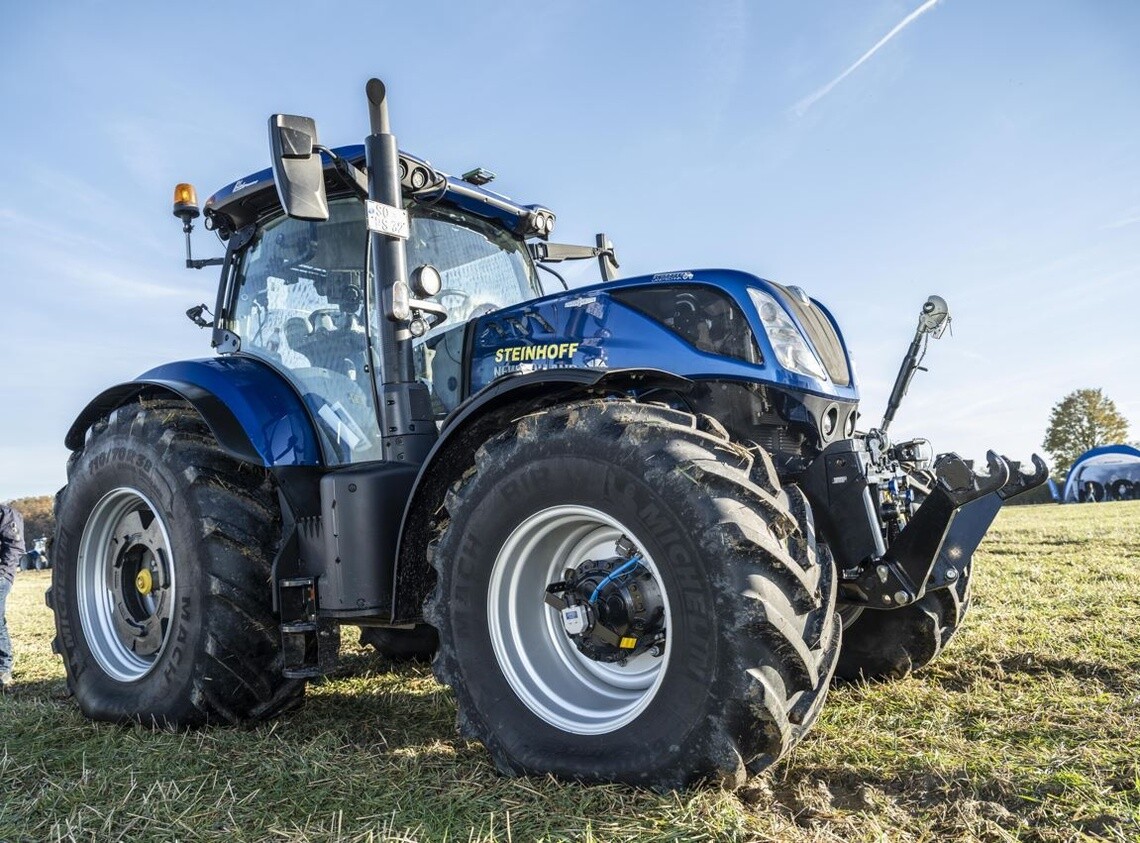
Adjust Your Agricultural Tire Pressure on Demand
A Central Tire Inflation System (CTIS) allows farmers to adjust tire pressure on tractors and other farming equipment directly from the cab. By adapting tire pressure for changing field and road conditions, CTIS can help improve traction, reduce soil compaction, limit wheel slip and optimize tire performance.
How Does a Central Tire Inflation System (CTIS) Work?
A Central Tire Inflation System (CTIS) allows farmers to adjust tire pressure directly from the cab as operating conditions change. Using a control system, valves and air lines connected to the tires, CTIS can inflate or deflate tires to help match pressure to field and road conditions.
Drivers can adjust tire pressure while on the move, making it easier to transition between fieldwork and road travel while maintaining the appropriate pressure for the application.
What Are the Advantages of a Central Tire Inflation System (CTIS)?
A Central Tire Inflation System (CTIS) helps farmers adjust tire pressure as operating conditions change, without leaving the cab. This makes it easier to use the appropriate tire pressure for fieldwork and road travel, helping improve traction, protect soil, reduce wheel slip and support efficient farming operations.
Adjust Tire Pressure From the Cab
Field and road conditions place different demands on agricultural tires. With CTIS, operators can adjust tire pressure from the cab as conditions change, helping optimize tire performance without stopping to manually change pressure
Want to Implement CTIS on Your Farming Equipment?
How Can CTIS Improve Farming Operations?
By adjusting tire pressure to match field conditions, CTIS can help farmers improve productivity, reduce fuel costs, protect soil and reduce wheel spin.
CTIS: Increase your productivity
Improve Productivity by Up to 4%*
Optimizing tire pressure for field conditions can help reduce wheel slip and increase working efficiency, supporting greater productivity and reduced fuel consumption.

CTIS: Reduce your cost
Reduce Fuel Costs by Up to 10%*
Adjusting tire pressure for field conditions can help reduce wheel slip and support more efficient fuel use, helping lower fuel costs during farming operations.

CTIS: Protect your soil
Reduce Pressure on Soil by Up to 33%**
Lower tire pressure in the field increases the tire's footprint, helping distribute equipment weight across a larger surface area, reduce soil pressure and limit soil compaction to help protect crop yield.

CTIS: Decrease wheel spin
Reduce Wheel Spin by Up to 30%*
Using the appropriate tire pressure for field conditions can improve traction and reduce wheel spin. It can also help limit rolling resistance, reduce tire wear and support longer tire life.

Why Tire Pressure Needs Change Between the Field and Road
Equipment is becoming heavier, faster and more powerful. Fields are farther apart. Roading needs higher pressures to deal with the heat, weight and speed, while field work requires the lowest possible pressure to ensure maximum traction and minimal ground pressure. Using a single tire pressure across changing road and field conditions can compromise performance. CTIS allows operators to adjust tire pressure as conditions change.
Why Is the Right Tractor Tire Pressure Important?
Using the right tractor tire pressure for field and road conditions can help protect soil, improve traction and support tire performance. Adjusting pressure for the application can also help reduce unnecessary tire wear and improve operating efficiency.
Tractor Tire Pressure and Crop Yield
Protect Crop Yield
Repeated passes by heavy farming equipment can increase soil compaction, which may restrict water infiltration and root development. Managing tire pressure can help reduce pressure on the soil and protect conditions that support crop growth.

Tractor Tire Pressure and Soil Compaction
Limit Soil Compaction
Using the appropriate tire pressure can increase the tire's footprint and distribute equipment weight across a larger surface area, helping reduce rut formation and limit soil compaction

Tractor Tire Life and Operating Efficiency
Support Tire Life & Operating Efficiency
Using the appropriate tire pressure for road and field conditions can help limit rolling resistance and unnecessary tire wear, supporting fuel efficiency and longer tire life

How Does Michelin Ultraflex Technology Support CTIS?
Michelin Ultraflex Technology tires are designed to operate at lower pressures while carrying the required load. When used with CTIS, these tires can help farmers take greater advantage of tire pressure adjustments between field and road conditions to support traction, soil protection and productivity.
What Central Tire Inflation System Does Michelin Recommend?
Michelin recommends the Central Tire Inflation System (CTIS) designed and produced by its affiliate company, PTG. With more than 30 years of experience in tire inflation technology, PTG provides CTIS solutions designed for agricultural equipment
PTG Central Tire Inflation System
What Farming Equipment Is Compatible With CTIS?
CTIS is compatible with a range of farming equipment, including tractors, fertilizer tankers, manure spreaders, planters and other implements. The system can support different tractor tire brands, tire ranges and equipment configurations.
How Does the Central Tire Inflation System Connect to My Tractor?
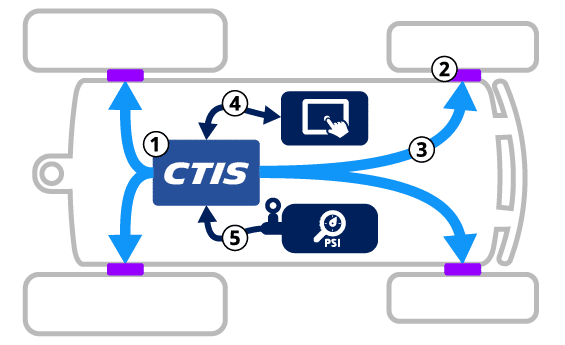
CTIS connects your tractor's air system, tires and in-cab controls to allow tire pressure to be adjusted while operating. The system uses five main components to manage inflation and deflation across the equipment
CTIS Tractor Connection System Diagram
CTIS includes:
- A central control system
- A rotary union at each wheel
- Air lines connecting the CTIS system to each tire
- A connection between CTIS and the in-cab terminal, such as ISOBUS
- A connection between CTIS and the tractor's air system
CTIS requires an air compressor, such as an air brake compressor. If your equipment does not have one, a CTIS dealer can provide an appropriate solution.
CTIS installation should be handled by a professional expert partner. For additional information about CTIS installation and system components, download the technical guide.
What Can I Control From the Cab With CTIS?
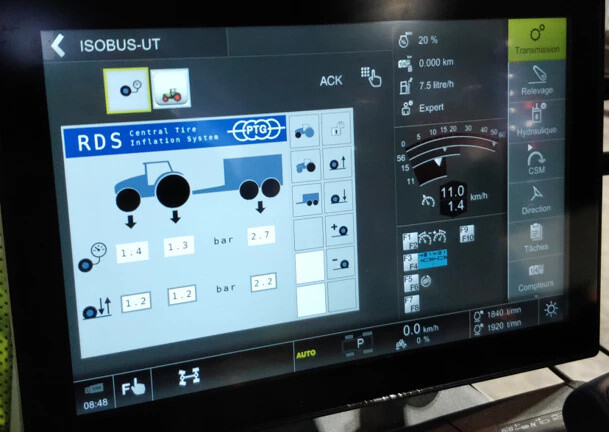
CTIS allows operators to manage tire pressure directly from the cab using an in-cab control terminal. From the driver's seat, you can adjust tire pressure as operating conditions, equipment loads and surfaces change.
From the cab, you can:
- Inflate or deflate tires on the move: Adjust tire pressure without stopping your farming equipment.
- Select the surface and load: Choose between road or field conditions and adjust for loads ranging from full to empty.
- Choose the axle: Select which axle you want to manage.
- Set high and low tire pressure ranges: Establish pressure settings for each axle based on operating needs.
- Manage up to 18 configurations: Integrate up to 18 different configurations into the ISOBUS terminal.
ISOBUS terminal example
Central Tire Inflation System (CTIS) FAQs
CTIS pricing depends on your farming equipment and system configuration. Contact a CTIS expert to provide information about your equipment and receive a custom quote.
CTIS installation typically takes between 10 and 12 hours per axle, although installation time can vary depending on the farming equipment. Contact a CTIS expert for installation guidance specific to your equipment.
CTIS is designed according to strict quality and safety standards, and most original equipment manufacturers (OEMs) have approved the use of CTIS on certain equipment. Because warranty requirements can vary by manufacturer and equipment, contact a CTIS expert with questions about your specific equipment.
Yes. If your farming equipment is not equipped with ISOBUS, an alternative digital solution is available to manage CTIS.
Yes. CTIS is designed to inflate or deflate tires on demand while farming equipment is in motion. The system is designed for safe operation while the vehicle is moving, with no CTIS-specific speed limit for inflation or deflation.
* Based on a field study carried out under real-life conditions in Scotland in 2016 using a Fendt 939 tractor fitted with Michelin Axiobib IF650/65R34 and Michelin Axiobib IF710/75R42 tires and a Stewart three-axle trailer fitted with Michelin Cargoxbib HF 600/55R26.5 tires. Soil test conditions: heavy blue clay. Also based on a field study carried out under real-life conditions in France in 2017 using a Fendt 724 Vario tractor fitted with Michelin Machxbib 710/55 R30 and Michelin Machxbib 900/50 R42 tires and a GYRAX BMXL 240 trailer fitted with Michelin Cargoxbib HF 710/50 R26.5 tires. Soil test conditions: clay-limestone. Actual results may vary depending on soil and weather conditions.
** Based on TERRANIMO calculations and a field study carried out under real-life conditions in France in 2020 by Bern University of Applied Sciences, School of Agricultural, Forestry and Food Sciences HAFL, at Michelin’s request, using a JOHN DEERE 7310 tractor fitted with Michelin MachXBib 600/70R30 and Michelin MachXBib 710/70R42 tires and a THIEVIN three-axle trailer fitted with Michelin TrailXBib 650/55R26.5 tires. Actual results may vary depending on soil and weather conditions.
*** External study commissioned by Michelin and carried out by "Tyre check" in Q4 2021 on the European geographical perimeter.