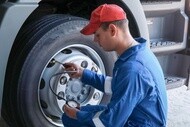
Commercial Truck Tire Pressure Check
Truck TPMS: How Tire Pressure Monitoring Helps Fleets
A truck Tire Pressure Monitoring System (TPMS) monitors tire pressure and alerts drivers or fleet teams when pressure needs attention. This added visibility can help fleets identify pressure issues earlier and make more informed tire maintenance decisions.
When combined with regular tire inspections and maintenance, tire pressure monitoring can help support tire performance, fuel efficiency, vehicle availability and overall operating costs.
IN THIS ARTICLE:
What Is Truck TPMS and How Does It Work?
A truck Tire Pressure Monitoring System (TPMS) uses sensors to monitor tire pressure while the vehicle is in operation. When pressure moves outside the system’s defined parameters, TPMS can alert the driver or fleet team so the tire can be evaluated.
From tire pressure to maintenance action
While capabilities vary by system, the basic process is straightforward:
• Tire pressure is monitored. Sensors collect pressure information from the tire.
• Data is transmitted. Tire information is sent to the vehicle or monitoring system.
• An alert identifies a condition that needs attention. This helps teams know when a tire should be checked.
• The fleet can respond. The tire can be inspected and the appropriate maintenance action determined.
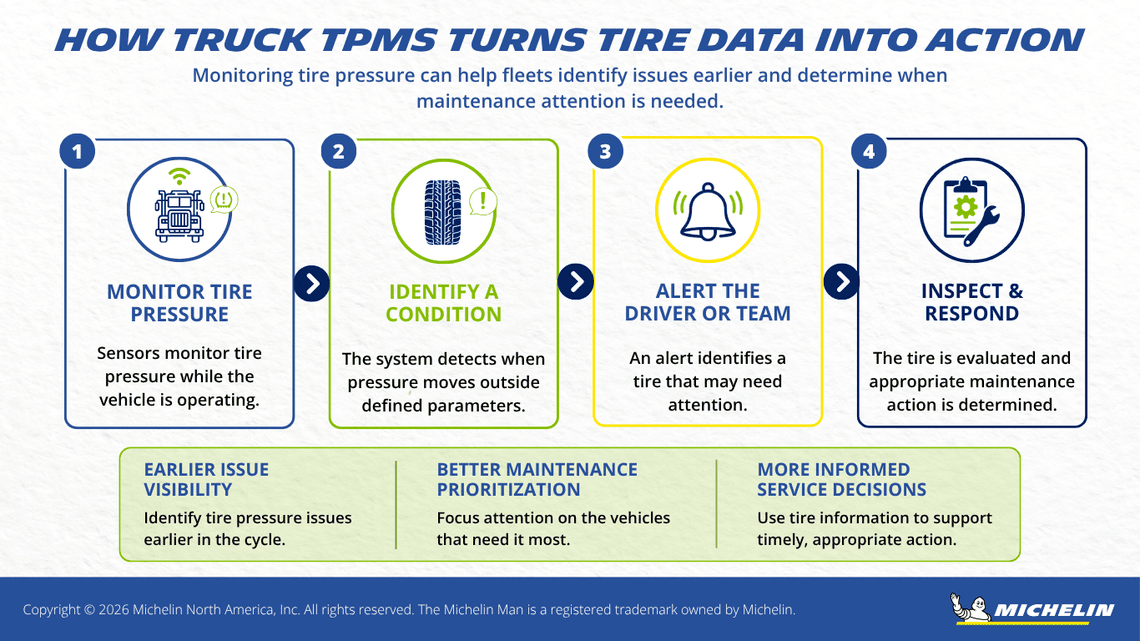
How Truck TPMS Turns Tire Data Into Action
For fleets managing multiple trucks, that visibility can make pressure monitoring more proactive. Instead of relying only on scheduled manual checks to uncover pressure issues, TPMS can provide information between inspections that helps teams identify which tires may need attention.
Important: TPMS capabilities, alert thresholds and the information available to fleet teams vary by system. Regular tire inspections remain an important part of tire maintenance.
What Can TPMS Help Fleets Monitor?
The primary role of TPMS is to give fleets greater visibility into tire pressure conditions while vehicles are operating. Depending on the system, that information may be available to the driver, maintenance team or through a connected fleet platform.
For many fleets, the value is not simply having more tire data. It is being able to identify which tires may need attention and respond before the next scheduled pressure check.
Pressure Changes and Alerts
TPMS can alert drivers or fleet teams when tire pressure moves outside defined parameters. This can help identify a developing pressure issue that might otherwise go unnoticed between routine inspections.
Alert thresholds and notification methods vary by system, so fleets should understand how their particular TPMS is configured and what action different alerts require.
Tire Conditions Across Multiple Vehicles
When TPMS data is connected at the fleet level, maintenance teams can gain visibility beyond the individual truck. Instead of relying solely on each driver to respond to an in-cab alert, teams may be able to identify vehicles or tires requiring attention across the fleet.
This becomes increasingly useful as fleet size grows because maintenance teams can use tire information to help prioritize which vehicles need inspection or service.
Trends That Can Inform Maintenance
Tire pressure information can also provide useful context over time. Repeated pressure loss or recurring alerts on the same tire may indicate that further inspection is needed rather than simply adjusting the pressure and returning the vehicle to operation.
The goal is to turn an alert into an informed maintenance decision: identify the condition, inspect the tire and address the underlying issue when necessary.
TPMS Works Best as Part of a Complete Tire Maintenance Program
TPMS gives fleets additional visibility into tire pressure, but it does not replace regular tire inspections. A monitoring system can identify pressure conditions that need attention, while a physical inspection can uncover wear, damage and other tire conditions that pressure data alone may not reveal.
For many fleets, the most effective approach is to use both TPMS and routine inspections.
TPMS and Physical Tire Inspections Work Together
TPMS can help fleets | Physical inspections can help identify |
|---|---|
Monitor tire pressure between scheduled inspections | Irregular or uneven tread wear |
Alert teams when pressure moves outside defined parameters | Cuts, punctures or other visible damage |
Identify tires that may need attention | Tread depth and overall tread condition |
Flag repeated pressure loss or recurring alerts | Valve, wheel and other visible tire conditions |
Help prioritize maintenance attention across vehicles | Embedded objects or other conditions requiring evaluation |
Use the Data as a Trigger for Action
An alert should be the beginning of the maintenance process, not the end. When TPMS identifies a pressure condition, the tire should be evaluated to understand why the pressure changed and determine the appropriate response.
Repeatedly adding air without investigating recurring pressure loss may leave the underlying condition unresolved.
In practice, TPMS adds another layer of information to tire maintenance. Regular inspections provide the physical context needed to turn that information into the appropriate maintenance action.
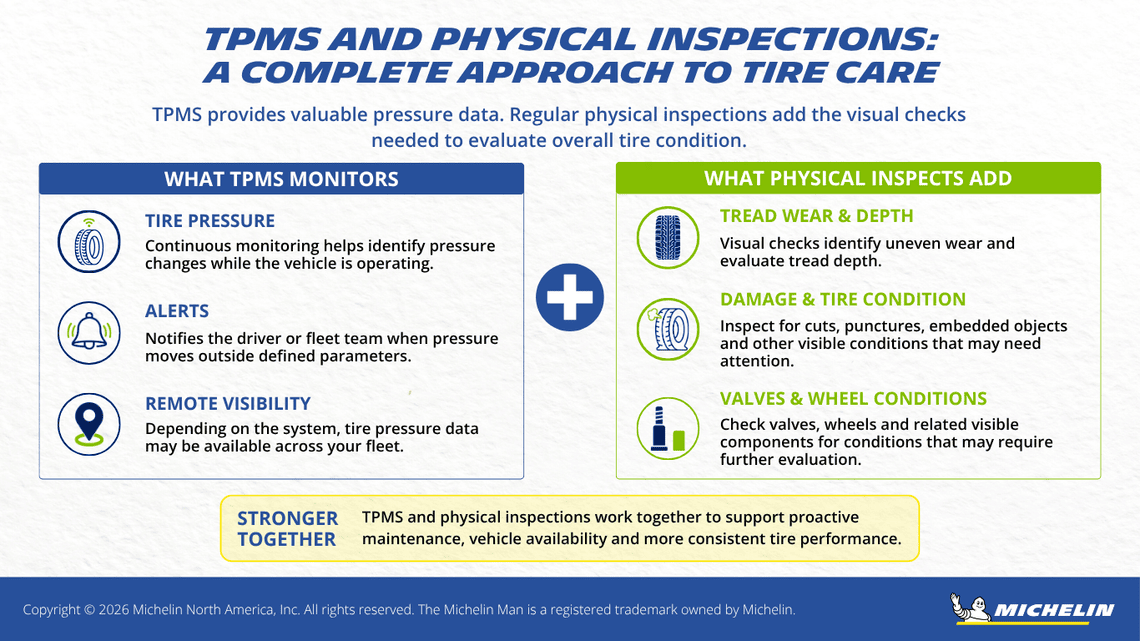
Truck TPMS and Physical Tire Inspections
Tire Pressure Monitoring Can Support Fleet Performance
Maintaining appropriate tire pressure is about more than the tire itself. Pressure conditions can influence how tires wear and perform, while tire-related maintenance needs can affect service schedules and vehicle availability.
TPMS gives fleets another way to identify pressure conditions earlier and make more informed maintenance decisions.
Monitoring tire pressure between inspections can help fleets identify conditions that may contribute to irregular wear or reduced tire performance.
When an alert occurs, investigating the cause rather than simply adjusting pressure can also help teams address recurring conditions and make better use of their tire investment.
Tire inflation can affect rolling resistance and, in turn, fuel consumption. Monitoring pressure can help fleets identify tires that need attention so appropriate inflation can be restored.
For fleets operating many vehicles and miles, consistent pressure management should be viewed as part of the broader effort to manage fuel and operating costs.
TPMS can provide maintenance teams with information between scheduled inspections. That added visibility can help identify which tires or vehicles may need attention and prioritize maintenance accordingly.
Fleets can use pressure alerts to help plan service before an issue becomes more disruptive.
Identifying tire pressure conditions earlier may give fleets more opportunity to address them through planned maintenance and reduce avoidable tire-related service disruptions.
What this means for fleets: Better pressure visibility can support more informed maintenance decisions, tire utilization, fuel efficiency and vehicle availability.
Move From Individual Alerts to Fleet-Level Visibility
An in-vehicle TPMS alert can tell a driver when a tire needs attention. For a fleet managing many vehicles, however, the bigger challenge is understanding which tires need attention, where they are and what should be prioritized first.
Connected tire-pressure monitoring can bring information from multiple vehicles into a broader fleet view. Depending on the system, maintenance teams may be able to review alerts remotely, identify vehicles that require attention and use that information to help prioritize service.
Why Fleet-Level Visibility Matters
As fleet size grows, relying only on individual drivers to receive and communicate tire alerts can make it harder for maintenance teams to maintain a consistent view across the operation.
Centralized visibility can help teams:
- See tire-pressure alerts across multiple vehicles
- Identify which trucks or tires may require attention
- Prioritize maintenance based on current tire information
- Recognize recurring pressure issues
- Use tire data alongside other maintenance information
The goal isn't simply to collect more data. It's to make the right tire information easier for fleet teams to act on.
Michelin Connected Fleet Helps Turn Tire Data Into Action
For fleets managing multiple vehicles, identifying a tire pressure issue is only part of the challenge. Maintenance teams also need visibility into which vehicles require attention so they can prioritize and plan the appropriate response.
Michelin Connected Fleet brings tire information into a cloud-based platform, giving fleet managers remote visibility into tire pressure alerts and helping teams use that information as part of their maintenance planning.
Centralized Tire Pressure Visibility
Instead of tire pressure information remaining only with the individual vehicle or driver, MICHELIN Connected Fleet can provide fleet managers with a broader view of tire conditions across connected vehicles.
This can help teams identify which vehicles need attention and prioritize inspections or service based on current tire information.
Alerts That Support Maintenance Planning
Customizable alert thresholds can help fleets align tire pressure notifications with their tire management policies. When an alert identifies a tire that needs attention, maintenance teams can use that information to help determine when the vehicle should be inspected or serviced.
That added visibility can make it easier to incorporate tire needs into planned maintenance rather than managing every issue reactively.
Support Beyond the Technology
Connected tire monitoring still needs to work within the fleet’s broader tire management program. MICHELIN Connected Fleet provides support to help fleets use the technology as part of their tire management approach, including sensor management following tire rotations or replacements.
See Michelin Connected Fleet Tire Monitoring in Action
See how connected tire monitoring gives fleet teams visibility into tire information and helps them identify vehicles that may need attention
For fleets, the opportunity is to move beyond receiving individual tire pressure alerts toward using tire data to support more informed, consistent maintenance decisions across the operation.
Additional Resources
Frequently Asked Questions About Truck TPMS
A Tire Pressure Monitoring System (TPMS) monitors tire pressure and alerts the driver or fleet team when pressure moves outside defined parameters. Depending on the system, tire information may also be available remotely to help maintenance teams identify vehicles or tires that need attention.
Truck TPMS uses sensors to monitor tire pressure and transmit that information to the vehicle or monitoring system. When pressure reaches a defined alert threshold, the system can notify the driver or fleet team so the tire can be inspected and the appropriate maintenance action determined.
No. TPMS provides valuable pressure information, but regular physical inspections are still important for identifying tread wear, damage, tread depth and other conditions that pressure monitoring alone may not detect. The two work best as complementary parts of a tire maintenance program.
TPMS can help fleets identify tire pressure conditions earlier, prioritize maintenance and maintain more consistent visibility between scheduled inspections. Better pressure management can also help support tire performance, fuel efficiency, vehicle availability and operating-cost control.
Depending on the system, yes. Connected tire monitoring can make tire-pressure information available beyond the individual vehicle, helping fleet teams see alerts across multiple trucks and identify which vehicles may need attention. Michelin Connected Fleet can provide remote tire-pressure visibility as part of a connected fleet-management approach.


