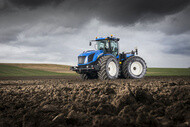
Agricultural Tractor in Field
Pneu MICHELIN AXIOBIB
How to Ballast Agricultural Tires With Liquid
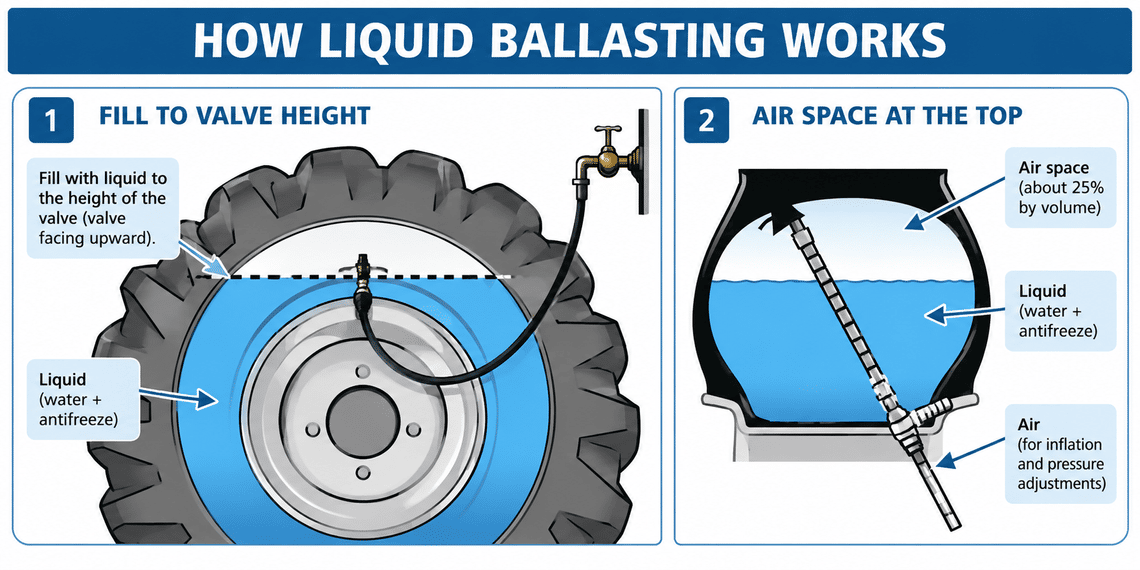
Agricultural Tire Liquid Ballasting Diagram
Agricultural Tractor in Field
Pneu MICHELIN AXIOBIB
Liquid ballasting involves adding liquid to agricultural tires to increase the machine's overall weight or lower its center of gravity. Both tube-type and tubeless agricultural tires can be ballasted using a liquid solution.
Agricultural tire valves allow tires to be filled with both liquid and air. When filling a tire with liquid, position the valve at the top and fill to valve height, leaving approximately 25% of the tire's volume for air.
Important considerations
Freezing temperatures: Use a suitable glycol-based antifreeze product when protection against freezing is required.
Product compatibility: Michelin does not manufacture liquid-ballasting products and does not accept responsibility under its guarantee for tire damage caused by these products.
Inflation pressure: Inflation and pressure adjustments can be made using air. Because liquid-ballasted tires contain a relatively small volume of air, Michelin recommends checking tire pressure monthly.
Agricultural Tire Liquid Ballasting Diagram
How liquid ballasting works in agricultural tires, showing the liquid fill level and remaining air space.
To fill a tubeless agricultural tire with liquid ballast, follow these steps:
Mount the tire. Assemble and mount the tire according to the instructions in Mounting and Dismounting Agricultural Tires.
Reduce tire pressure. Deflate the tire to approximately 8 psi.
Position the valve. Rotate the tire until the valve is at the top.
Add liquid ballast. Fill the tire to approximately 75% of its volume with the water and antifreeze solution, allowing air to escape during filling. Refer to the liquid ballasting diagram above.
Adjust tire pressure. Finish inflating the tire with air and adjust the pressure as required.
Learn more about agriculture tire care, maintenance and performance with these Michelin resources:
• Reading and understanding tire markings
• How to reduce soil compaction
• Find the right rim, tube, and valve fitments
Find more Michelin resources, guidance and tire solutions for farm operations.
You are using and outdated Web Browser.
You are using a browser that is not supported by this website. This means that some functionality may not work as intended. This may result in strange behaviors when browsing round.
Use or upgrade/install one of the following browsers to take full advantage of this website


