Finalize my selection 0

You have not selected a product

Commercial truck undergoing maintenance in a fleet service shop with truck tires prepared for inspection and potential retreading to extend tire life and reduce operating costs.

Fleet Maintenance Shop Preparing Truck Tires for Retreading

Industrial grade white big rig semi truck with open hood with a possibly broken engine standing with disassembled parts inside the repair shop awaiting for repair and maintenance technician

Can Retread Tires Reduce Fleet Operating Costs?

For many fleets, tires represent one of the largest ongoing operating expenses. Retread tires can help lower tire costs by extending the life of quality casings, but they are not the right solution for every application. Understanding how retreading works, when a tire qualifies and how it fits into a long-term tire strategy can help fleets make more informed purchasing decisions.
 

SUMMARY:

How Can Retread Tires Reduce Fleet Operating Costs?

Replacing truck tires is a significant operating expense for many fleets. Retreading can help reduce those costs by extending the usable life of a quality tire casing instead of replacing the entire tire each time the tread wears out.

When a casing remains in good condition and passes inspection, a new tread can be applied, allowing the tire to return to service. This multi-life approach helps fleets spread the original tire investment across more miles while supporting a lower cost per mile. Understanding your fleet's cost per mile can help quantify the long-term financial value of extending tire life through retreading.

Retreading is most effective when paired with proactive tire maintenance. Proper inflation, regular inspections and timely repairs help protect the casing so it remains eligible for future retreads.

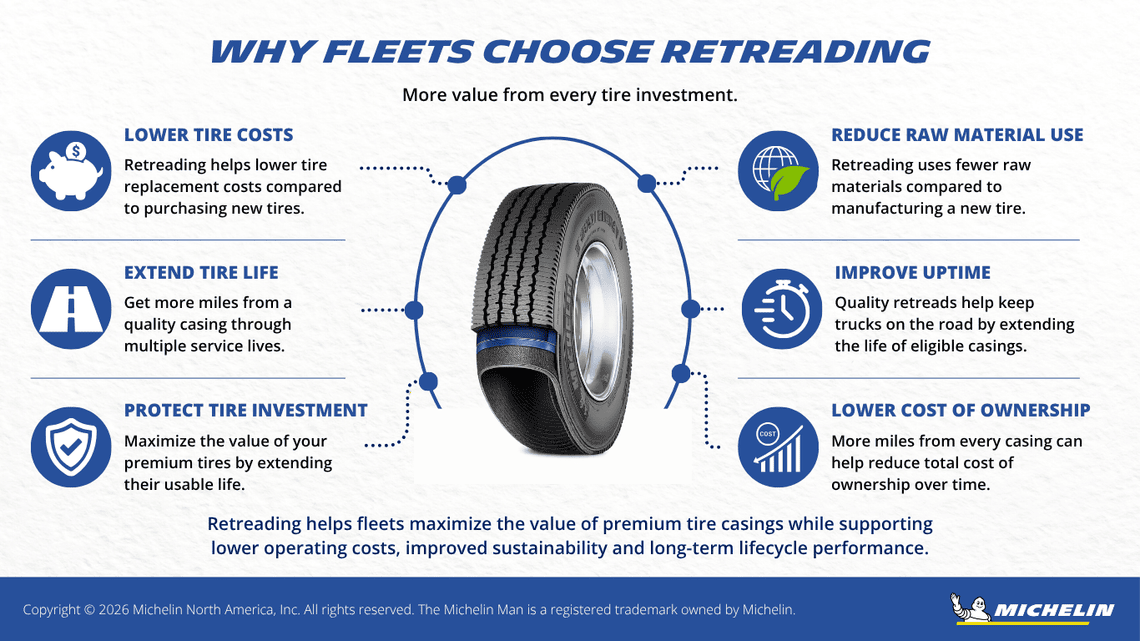
Infographic highlighting the key benefits of truck tire retreading, including lower tire replacement costs, extended tire life, protecting tire investment, reduced raw material use, improved fleet uptime and lower total cost of ownership.

Benefits of Truck Tire Retreading for Fleets
Are Retread Tires Safe and Reliable?

Retread tires have been used by commercial fleets for decades because they can deliver reliable performance while helping reduce operating costs. When a quality casing passes a professional inspection and the retreading process follows established manufacturing standards, a retreaded tire is designed to perform in demanding fleet applications.

The key is understanding that not every tire is automatically retreaded. Every casing is thoroughly inspected before it can be approved for another service life. If it does not meet inspection standards, it is removed from the retreading process rather than returned to the road.

This inspection-first approach helps ensure that only qualified casings are selected for retreading.

Before a tire can be retreaded, technicians inspect factors such as:

  • Overall casing condition and structural integrity
  • Sidewall, bead and belt area condition
  • Previous repairs and repair quality
  • Signs of irregular wear or operational damage
  • Compliance with retread inspection standards


Not every truck tire qualifies for retreading. Proper tire maintenance throughout the tire's first service life helps protect the casing and improves the likelihood that it can be successfully retreaded.

Retread Eligibility Starts with the Tire Casing

Not every truck tire is a candidate for retreading. The condition of the tire casing ultimately determines whether it can safely move into another service life. That's why protecting the casing from the day a new tire is installed is an important part of any long-term tire strategy.

When the original tread reaches the end of its service life, the casing undergoes a professional inspection. If it meets established inspection standards, a new tread can be applied, allowing the tire to return to service. If the casing has sustained structural damage or excessive wear, it is removed from the retreading process.

Inspection Area

Why It Matters

Casing condition

The casing must remain structurally sound to support another service life.

Proper tire inflation

Underinflation generates excessive heat that can permanently damage the casing.

Regular tire inspections

Identifying and repairing minor issues early can help prevent damage that makes a casing unsuitable for retreading.

Tread wear

Tires should be removed for retreading before excessive wear affects the casing.

Operating conditions

Overloading, impact damage and harsh operating environments can reduce casing life.


Protecting the casing starts on day one

A tire's retreadability is influenced long before it reaches the retread plant. Proper inflation, routine inspections, wheel alignment and selecting the right tire for the application all help protect the casing throughout its first service life. By maintaining tires proactively, fleets may improve the likelihood that quality casings remain eligible for future retreading, helping maximize tire life and support a lower total cost of ownership.

Learn how tire retreading can extend tire life and help lower fleet operating costs.

Retreading Supports a More Sustainable Tire Strategy

While many fleets first consider retreading to help reduce operating costs, it can also support broader sustainability initiatives. By extending the service life of a quality tire casing, retreading reduces the demand for new raw materials and helps maximize the value of resources already in use. This multi-life approach supports a more circular tire strategy while helping fleets get more value from every tire.


Key sustainability benefits of tire retreading include:

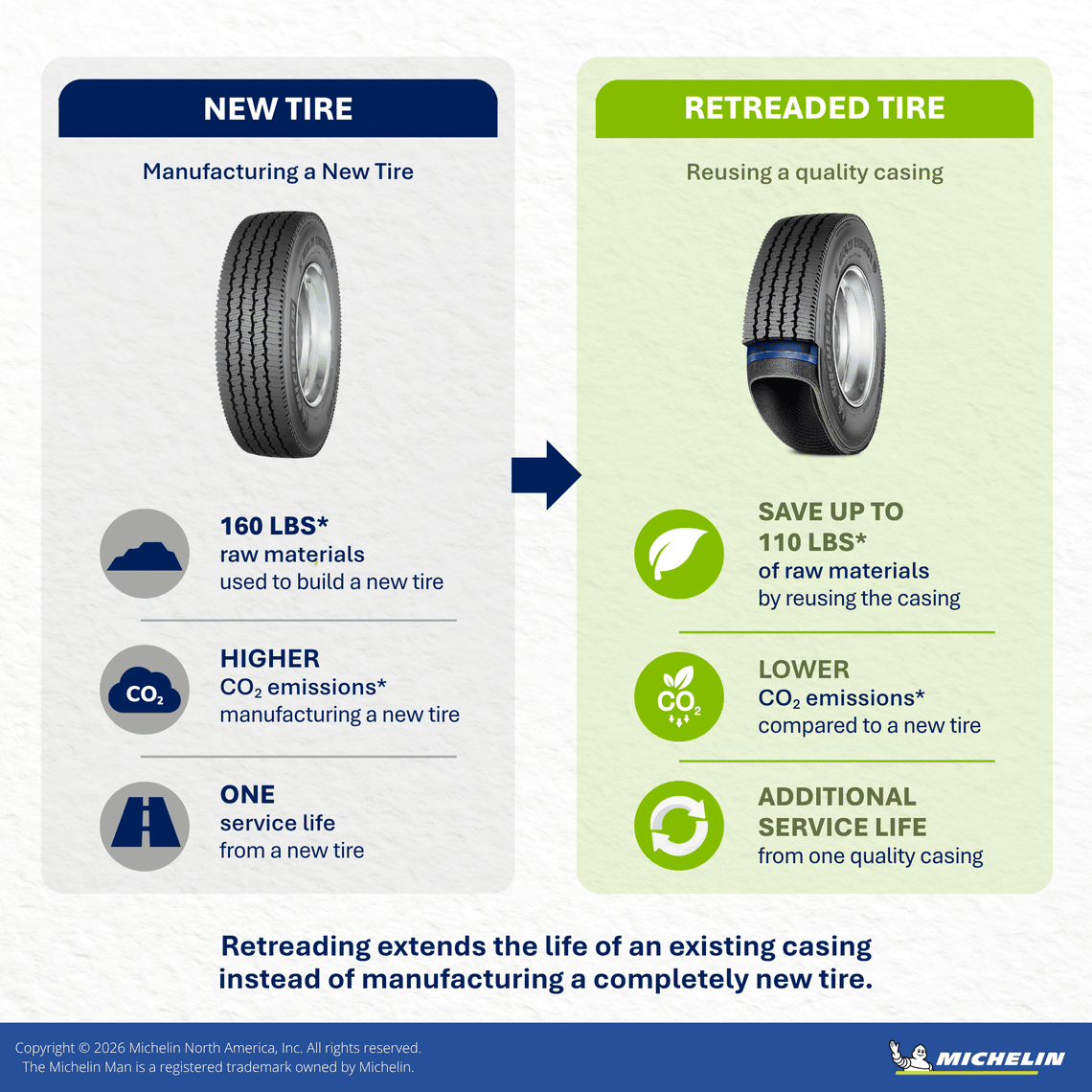
  • Reducing raw material consumption. Each Michelin retread can save up to 110 pounds (50 kg)(1) of raw materials, representing approximately a 70% reduction compared to manufacturing a new tire.
     
  • Reducing CO₂ emissions. Retreading 100 tires can prevent more than 12.8 tons (11.6 metric tonnes) of CO₂(2) from being released into the atmosphere.
     
Comparison infographic showing how truck tire retreading supports sustainability by reusing quality tire casings, reducing raw material consumption, lowering CO₂ emissions compared to manufacturing a new tire and extending tire service life.

Retread Tires vs. New Tires: Sustainability Comparison

By extending the life of quality tire casings, retreading can help fleets lower operating costs while also supporting sustainability goals through a more efficient use of materials and resources. Combined with proper tire selection and maintenance, retreading is part of a broader strategy to reduce fuel consumption and improve overall fleet efficiency.

Application Note: Retread tires are generally intended for drive and trailer axle positions. Michelin does not recommend mounting retreaded tires on steer axles.

Michelin Technologies That Help Protect the Tire Casing

Retreading begins long before a tire reaches the retread plant. The durability and condition of the casing are influenced by the tire's design, materials and performance throughout its first service life. Michelin technologies are designed to help protect the casing so that, when appropriate, it has the potential to deliver value across multiple service lives.
 

Improved casing durability with new-generation steel cords

Improved casing durability with new-generation steel cords

Michelin POWERCOIL Technology

Purpose
Stronger steel cables help improve casing durability.

Fleet Benefit
Supports casing integrity and long-term retread potential.

Reinforced heel with premium nylon

Reinforced heel with premium nylon

Michelin DURACOIL Technology

Purpose
Reinforces the bead area.

Fleet Benefit
Helps protect the casing during mounting and operation.

Reinforced casing with a continuous steel wire

Reinforced casing with a continuous steel wire

Michelin INFINICOIL Technology

Purpose
Continuous steel wire improves stability and promotes even wear.

Fleet Benefit
Supports casing durability throughout the tire's service life.

Together, these technologies help protect the tire casing from day one, supporting a multi-life tire strategy designed to maximize tire value over time.

Retreading Is Part of a Smarter Tire Strategy

Retreading is most effective when it's part of a proactive tire management strategy, not simply a decision made when tread wears out. Choosing quality tires, maintaining proper inflation, performing regular inspections and protecting the casing throughout its first service life can help fleets maximize tire value over more miles.

For fleets focused on lowering operating costs, improving sustainability and reducing downtime, retreading can play an important role in a long-term lifecycle approach. When combined with quality tire selection and consistent maintenance practices, it helps extend the value of every qualified casing while supporting a lower total cost of ownership.

LEGAL MENTIONS

((1) In terms of material savings, the average weight of a new Michelin tire is 154 lbs (70 kg)*. The weight of a tire ready to be retreaded is 110 lbs (50 kg)** on average.
*Internal study based on the Michelin truck tire sizes most sold on the European market: 315/80 R 22.5, 315/70 R 22.5 and 385/65 R 22.5.
*
According to a TNPF publication from 2023: “retreading, which, by reusing the casing that represents approximately 70% of a tire's weight” (sic). As a result, 70% of 154 lbs (70 kg) = approximately 110 lbs (50 kg).

(2) The CO₂ saving associated with the retreading operation is calculated from the associated material saving. In terms of material saving, a Michelin Remix® retreaded tire covers up to 100% of the mileage of a new Michelin tire (7). A new tire weighs 154 lbs (70 kg) on average. A new tire ready to be retreaded weighs 110 lbs (50 kg) on average. The CO₂ impact of a retreaded tire is linked to the material saving, or 254 lbs (115 kg) of CO₂, representing 110 lbs (50 kg) of raw material savings, at a rate of 2.3 lbs of CO₂ per lb of raw materials (2.3 kg of CO₂ per kg of raw materials).

You are using and outdated Web Browser.

You are using a browser that is not supported by this website. This means that some functionality may not work as intended. This may result in strange behaviors when browsing round.

Use or upgrade/install one of the following browsers to take full advantage of this website

Firefox 78+
Edge 18+
Chrome 72+
Safari 12+
Opera 71+