
A fleet of electric vans with a charging station in the foreground
Fleet electrification is changing the operational profile of last-mile delivery.
As electric vehicles become more mainstream in urban operations, owners and fleet managers are discovering that procurement decisions made for internal combustion vehicles don't always translate directly to electric applications.
The shift creates unexpected complications across route planning, maintenance schedules and operational protocols. But there's one area where the disconnect is particularly costly: tire performance. Most fleet owners view tire selection as a straightforward commodity purchase, yet tires behave fundamentally differently under electric vehicle operating conditions.
The impact often goes unnoticed until operators are managing unexpected tire replacements, reduced vehicle range or increased maintenance downtime. By then, the patterns are already affecting operational efficiency and bottom-line costs.
This guide covers:
Do Electric Vehicles Need Different Tires?
Electric vehicles do not necessarily need special tires. Quality commercial tires perform well on both internal combustion and electric vehicles.
However, when selecting tires for your electric fleet, understanding how electric vehicles influence tire wear patterns and service life helps inform procurement decisions that impact the total cost of ownership.
Factors that may affect electric vehicle tire performance:
Increased Vehicle Weight
Electric vehicle batteries add significant weight compared to diesel or gas equivalents. This additional weight accelerates tire wear and stresses tire construction, particularly sidewalls. In urban delivery with frequent curb contact and tight maneuvering, heavier vehicles increase sidewall damage risk.
Instant Torque Delivery
Electric motors deliver maximum torque from zero RPM, unlike internal combustion engines that build torque gradually. In last-mile delivery with multiple stops per route, each acceleration event from a standstill applies maximum torque to the tire tread, accelerating wear.
Stop-and-Go Duty Cycles
Urban delivery operations involve constant starting and stopping on each route. Each stop creates braking stress and each acceleration places torque on the tire tread. This pattern, repeated dozens of times per route and hundreds of times weekly, creates a more demanding wear environment than highway or regional operations.
What This Means for Tire Procurement
Purchase price and basic load ratings, the primary factors in many diesel fleet tire decisions, don't adequately address electric vehicle performance requirements.
Electric vehicle tire evaluation criteria should include:
- • Sidewall construction and protection features
- • Tread compound designed for high-torque applications
- • Rolling resistance specifications and range impact
- • Wear consistency in stop-and-go duty cycles
- • Acoustic design characteristics
Understanding these performance factors is the first step. The next question is: which factors have the greatest impact on your operational costs and how do you evaluate tires against them?
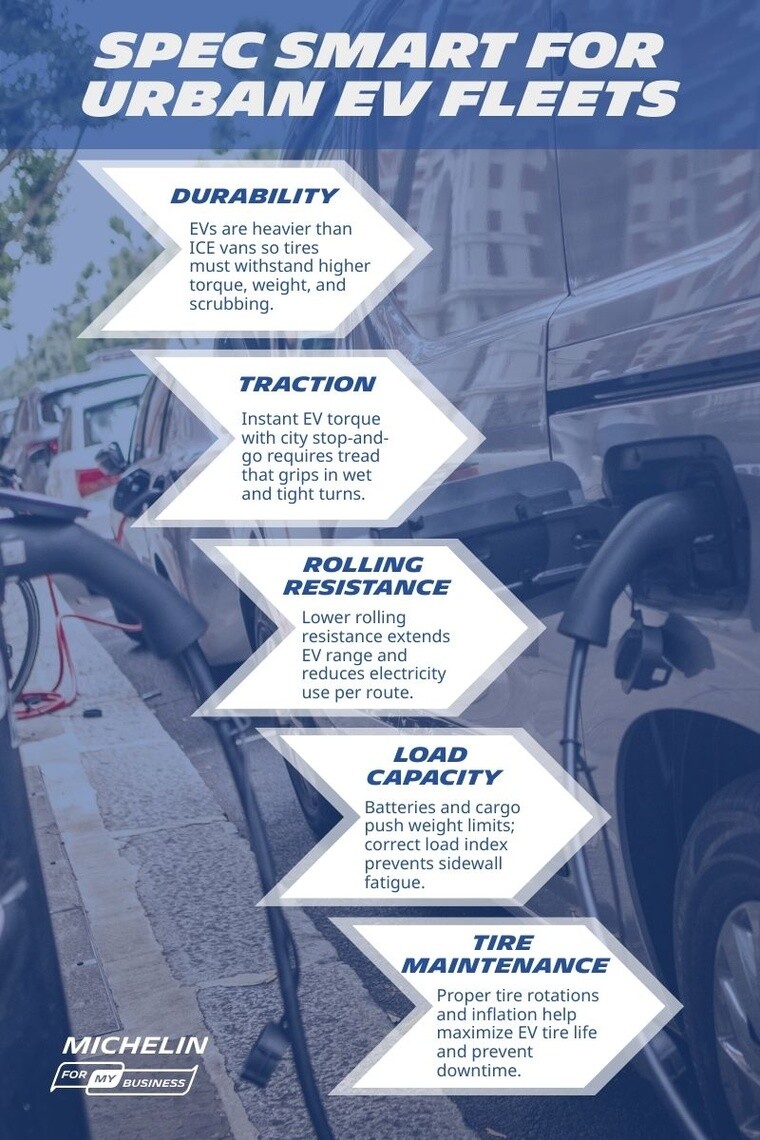
Michelin for My Business infographic of spec smart for urban ev fleets
Tire Factors That Impact Electric Fleet Operating Costs
When evaluating tires for electric fleet applications, there are two performance factors that have the greatest impact on total cost of ownership: wear life and sidewall durability. Both factors influence direct costs and operational efficiency.
Tire Wear
Tire wear life determines replacement frequency. In electric vehicles, heavier weight and instant torque delivery accelerate wear compared to internal combustion vehicles, particularly in urban delivery with constant start-stop cycles.
Each tire replacement includes costs beyond the tire itself, such as:
- • Labor for mounting and balancing
- • Vehicle downtime during service
- • Emergency roadside service when failures occur mid-route
- • Route coverage disruption
Tires that wear faster compound these costs across the entire fleet.
Sidewall Durability
Urban delivery operations expose tires to frequent curb contact during parking, tight street navigation and loading/unloading maneuvers. Electric vehicles' increased weight amplifies the impact of these encounters on tire sidewalls.
Sidewall damage often forces premature tire removal even when tread depth remains adequate. Mid-route failures require emergency roadside service and disrupt delivery schedules while vehicles sit out of service.
Rolling Resistance
Rolling resistance affects energy consumption in electric vehicles, influencing how many miles a vehicle can travel on a single charge. Lower rolling resistance tires help reduce charging frequency, especially on rural and regional routes where vehicles make fewer stops and accelerations.
For fleet managers, fewer charging cycles translate to reduced downtime and better asset utilization.
Why These Factors Matter Together
Wear life, sidewall durability, and rolling resistance don't operate independently – together they determine whether your tire investment delivers its full value or fails prematurely.
A tire with excellent tread compound but weak sidewall construction may never reach its wear potential if sidewall damage forces early removal. Similarly, a tire with low rolling resistance may reduce charging frequency, but if it wears quickly, the benefit is offset by more frequent replacement cycles and associated downtime.
For owners and fleet managers, tire selection requires evaluating multiple performance characteristics together, not just purchase price or a single specification. The right tire choice addresses all three factors to optimize the total cost of ownership across your electric fleet operations.
Real-World Application: The Michelin Agilis CrossClimate 2 Tire
The performance factors we've discussed: wear life, sidewall durability and rolling resistance, directly impact tire-related operating costs. The Michelin Agilis CrossClimate 2 tire was engineered specifically to address these factors in urban delivery applications.
Extended Wear Life Where it Matters Most
The Michelin Agilis CrossClimate 2 tire delivers 35% more mileage than a leading competitor.1
Beyond an extended lifespan, this means fewer replacements across your fleet meaning vehicles spend more time on the routes and less time waiting on tire changes.
Technologies drive this performance:
StabiliBlok TreadTechnology – Engineered into the tread material and design to maximize wear life under heavy loads and high torque. This directly addresses what electric vehicles create in last-mile operations.
MaxPressure Profile Design – Optimizes how the tire's contact patch distributes load across the tread, extending service life even under the increased weight electric vehicles carry.
These technologies work together to address the accelerated wear that electric vehicle weight and instant torque create in stop-and-go urban-duty cycles.
Sidewall Protection for Urban Environments
The Michelin Agilis CrossClimate 2 tire is designed with up to 72% thicker sidewall rubber than a leading competitor to defend against curb damage2 – giving your fleet the durability and reliability it needs to stay on schedule and on budget.
This tire is equipped with CurbGard sidewall protectors. These reinforced bands protect the tire from the damage caused on urban routes during parking, maneuvering and loading operations.
Year-Round Performance
The Agilis CrossClimate 2 carries the 3PMSF (Three-Peak Mountain Snowflake) certification, meeting severe snow traction standards. In fact, the Michelin Agilis CrossClimate 2 tire provides 35% better snow traction than a leading competitor.3
Additionally, SipeLock Technology provides hundreds of biting edges for grip in both wet and snowy conditions without sacrificing durability or tread life..
What this means operationally: One tire runs year-round. No seasonal changes, simplified inventory and reduced service scheduling complexity.
The Bottom Line for Electric Fleets
Electric vehicles create unique tire demands in urban delivery: heavier weight accelerates wear, instant torque stresses tread compounds and tight urban maneuvering increases sidewall damage risk. The Agilis CrossClimate 2 was engineered to handle these specific conditions while maintaining year-round performance.
Owners and fleet managers transitioning to or expanding electric delivery operations must consider how tire selection affects replacement frequency, vehicle uptime and casing retread potential.
Over time, these factors compound across your fleet to impact the total cost of ownership. The Agilis CrossClimate 2 is backed by a 60-day satisfaction guarantee4 and a 20% more mileage satisfaction guarantee5, reflecting confidence in its performance in these demanding applications.
Make Tire Strategy Part of Your Fleet Electrification Planning
Fleet electrification requires evaluating every operational variable, from charging infrastructure to maintenance protocols. Tire selection deserves the same strategic attention you give to those more visible decisions.
The cost difference between a well-optimized and poorly optimized tire strategy increases with every vehicle you add to your electric fleet. Tires that wear faster or fail prematurely create expenses that extend well beyond purchase price and affect vehicle uptime, maintenance scheduling and total cost of ownership.
The advantage goes to fleet managers who address tire strategy proactively before operational patterns reveal costly gaps in their procurement decisions.
Next Steps:
1. Assess Your Current Tire Performance – If you're already running electric vehicles, analyze your tire replacement patterns, failure modes and total tire-related costs. Compare these against your historical internal combustion fleet data to identify where performance differs.
2. Evaluate Tire Options for Your Duty Cycle – Not all "EV-ready" tires address the specific demands of urban delivery operations. Look for tires engineered for high-load, high-torque and stop-and-go applications with documented performance in conditions similar to your routes.
3. Connect with Tire Engineering Expertise –Contact a Michelin commercial tire dealer to determine which tires would be best for your operation.
4. Calculate Total Cost of Ownership – Move beyond purchase price comparisons to evaluate cost-per-mile across the tire's full life cycle, including labor, downtime, emergency service and retread potential.
Strategic fleet owners and managers build tire selection into their electrification planning rather than treating it as an afterthought. Tires like the Michelin Agilis CrossClimate 2 are engineered specifically for the demands electric vehicles create in urban delivery. They represent the kind of strategic investment that protects fleet ROI as your operation evolves.
The question isn't whether to optimize your tire strategy. It's whether you'll do it proactively as part of your transition planning or reactively after operational costs reveal what you missed.
Frequently Asked Questions about Fleet Electrification and Tire Selection
Electric vehicles don't necessarily need special tires, but they should have tires engineered to handle different performance demands. Electric vehicles are significantly heavier due to battery packs and deliver instant torque from zero RPM. These characteristics affect how tires wear and perform compared to internal combustion vehicles.
The key is selecting tires designed for the specific duty cycle and load conditions electric vehicles create, rather than assuming tires that worked for your diesel fleet will perform the same way.
Electric vehicle tires can wear faster due to three primary factors: increased vehicle weight from battery packs (adding constant stress on tire construction), instant torque delivery from electric motors (applying maximum torque from every stop) and the stop-and-go duty cycles common in urban delivery operations.
Yes. Urban delivery operations involve frequent curb contact during parking, tight street navigation and loading operations. Sidewall damage often forces premature tire removal even when tread depth remains adequate, eliminating remaining tread life and casing retread value.
Sidewall construction varies significantly between tire manufacturers. Enhanced sidewall protection helps tires survive daily urban delivery contact and preserves casing integrity for retread programs.
Yes, if the tire casing remains structurally sound and the tire is marked “retreadable.”
Sidewall damage can prevent a casing from being retreaded, eliminating the multi-life value of the initial tire investment. This is why sidewall construction matters in urban delivery applications where curb contact is frequent.
Replacement timing depends on tread depth, tire condition and operational requirements. Electric vehicles may require more frequent tire replacement than historical data from internal combustion fleets would suggest, due to accelerated wear from vehicle weight and torque delivery.
Regular tire inspections should assess tread depth, irregular wear patterns, sidewall condition and overall tire integrity. Tire selection affects replacement frequency; tires engineered for high-load, high-torque applications typically deliver longer service life in electric vehicle duty cycles.
(1) Based on an internal treadwear test using tires in size LT225/75R16 on 2023 Ram Promaster vans loaded to 6,800lbs / 3,100kg, Michelin Agilis CrossClimate 2 tire versus the Firestone® Transforce HT3 tire. Actual on-road results may vary.
(2) Based on measurements of the sidewall material thickness between the casing ply and the exterior face of the tire for the Michelin Agilis CrossClimate 2 tire and Goodyear® Wrangler Workhorse HT tire, both LT225/75R16 size.
(3) Based on third-party snow traction test using ASTM Test Method F1805 on LT225/75R16 tire size versus the Goodyear® Wrangler Workhorse HT tire. Actual on-road results may vary.
(4) 60-Day Satisfaction Guarantee - If you’re not 100% satisfied with your new tires, just bring the tires and original sales receipt back to the place where you bought the tires within 60 days of your purchase, and we will gladly exchange them for a new set of tires of equal or lesser value. Certain conditions and limitations apply. See the Michelin Owner’s Manual for complete description and details.
(5) 20% More Mileage Satisfaction Guarantee – If the Michelin Agilis products do not provide 20% more mileage performance than your current light truck or medium-duty truck tires, we’ll make up the difference of your acquisition price per tire. Valid only for the Michelin Agilis products. Guarantee requires proper tire maintenance and does not cover road hazards. Applicable to a maximum of 50 tires per ship-to location/customer. Valid for on-road commercial applications only. (1) Valid only against competitor tire brands. (2) Proof of purchase with date and purchase price necessary as well as mount and dismount tire mileage records for the mileage guarantee. Guarantee will pay in the form of a credit for the difference of your acquisition price per tire. Credit will be issued and all documentation must be validated by a Michelin Sales Representative. Michelin reserves the right to modify or discontinue this program at any time for any reason without prior notice. See your local Michelin dealer or sales representative for more details.


