
Why is truck tire pressure essential for your business?
Commercial Truck Tire Pressure: Why Proper Inflation Matters
Proper commercial truck tire pressure depends on factors such as tire size, load, axle position and operating conditions. Maintaining inflation pressure appropriate for the application can help support tire performance, fuel efficiency, casing condition and more predictable fleet maintenance.
IN THIS ARTICLE:
Why proper tire pressure matters
A commercial tire is designed to carry a specific load at a corresponding inflation pressure. When inflation does not match the tire's operating requirements, the way the tire carries the load and interacts with the road can change.
In practice, incorrect inflation can affect:
- Tire wear: Incorrect inflation may contribute to irregular or accelerated wear.
- Fuel efficiency: Underinflation can increase rolling resistance, which may contribute to increased fuel consumption.
- Casing condition: Excessive heat or stress can affect the casing and its potential for future use.
- Maintenance: Pressure-related tire issues can lead to additional inspections, repairs or tire removals.
- Operational continuity: Tire-related service events can take vehicles out of operation and disrupt schedules.
For a fleet, the goal isn't simply to keep tires inflated. It's to maintain inflation appropriate for the load and application.

Row of trucks
What happens when truck tires are underinflated or overinflated?
Both underinflation and overinflation can affect how a commercial truck tire performs. The effects differ depending on whether the tire is operating below or above the inflation pressure appropriate for its load and application.
Inflation condition | What can happen | Potential fleet impact |
Underinflation | Increased tire flexing and heat generation; changes in tread contact and wear | May contribute to increased rolling resistance, fuel consumption, tire wear and tire-related service events |
Overinflation | Changes in the tire's footprint and wear characteristics | May contribute to irregular wear and affect how the tire responds to road impacts |
Appropriate inflation for the load | Helps the tire carry its intended load under the specified operating conditions | Can support tire performance, wear management and lifecycle planning |
Underinflated commercial truck tires
When a tire operates below the inflation pressure required for its load, it can flex more than intended. That additional flexing can generate heat and increase rolling resistance.
Over time, underinflation may contribute to irregular wear, increased fuel consumption and casing damage. For high-mileage fleets, recurring underinflation can become an important maintenance and operating-cost consideration.
Overinflated commercial truck tires
More pressure isn't necessarily better. Inflation above the pressure appropriate for the tire's load can alter the tire's footprint and wear characteristics.
Depending on the tire and application, overinflation may contribute to irregular wear and affect how the tire responds to road impacts. The better approach is to establish inflation based on the tire's load and operating requirements rather than assuming a higher PSI is better.
How tire pressure can affect fleet operating costs
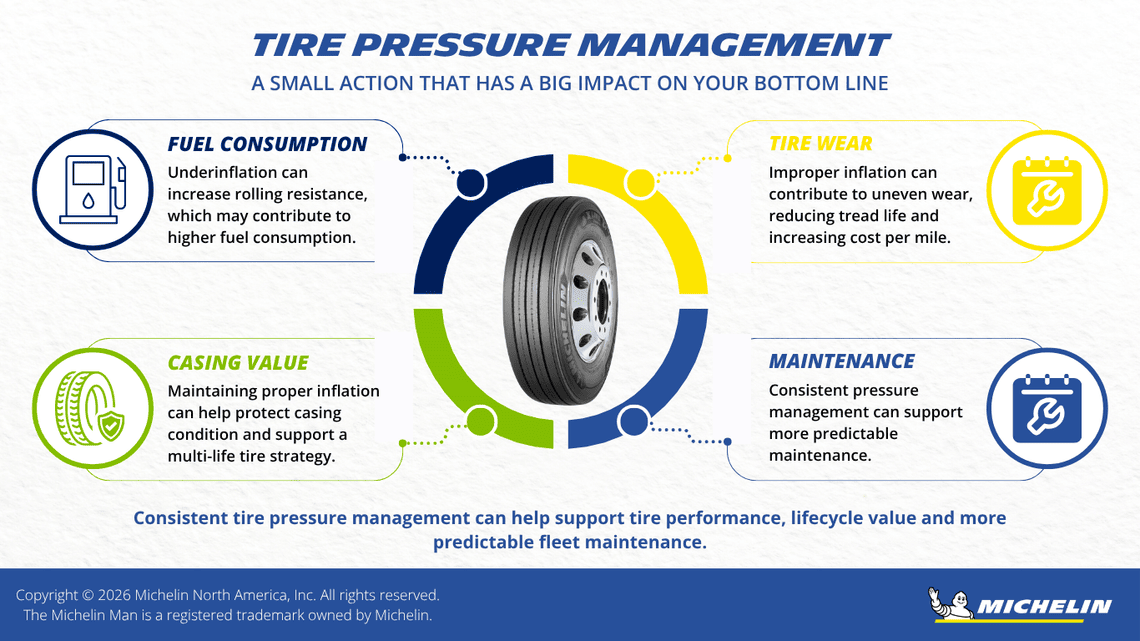
How Tire Pressure Can Affect Fleet Operating Costs
Tire pressure can affect more than fuel consumption. Over a commercial tire’s lifecycle, incorrect inflation may also contribute to tire wear, casing condition and additional maintenance needs.
Pressure management matters because several fleet costs are connected to how tires perform over time.
Fuel consumption. Underinflation can increase rolling resistance. Because the vehicle must overcome that additional resistance, fuel consumption may increase.
Tire wear. Incorrect inflation can change how the tread contacts the road, potentially contributing to irregular wear and earlier tire removal.
Casing value. For fleets using a multi-life tire strategy, casing condition matters. Maintaining tires appropriately throughout their first life can help preserve the casing for evaluation as a retread candidate. Not every casing will qualify for retreading.
Maintenance and operational continuity. Finding and correcting pressure issues during planned inspections can help fleets address problems before they contribute to unplanned service events.
This is where tire pressure becomes part of total cost of ownership. A pressure check is a small maintenance action, but tire condition across the full lifecycle can influence cost per mile, replacement planning and operational predictability.
How do you determine the correct tire pressure for a commercial truck?
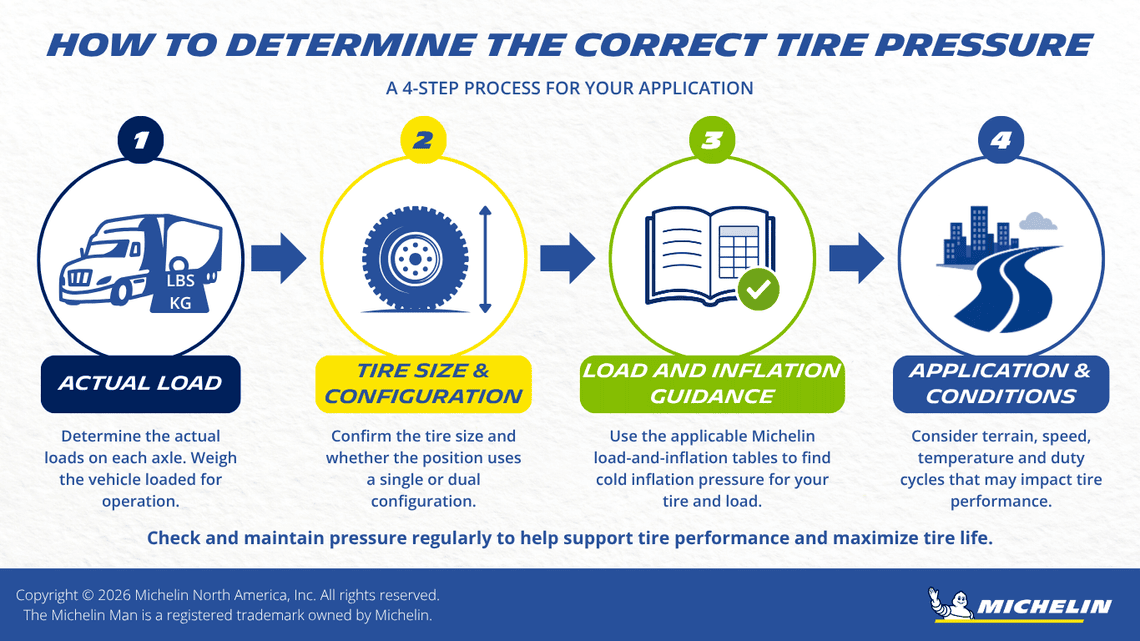
How to Determine the Correct Commercial Truck Tire Pressure
There isn't one PSI recommendation that applies to every commercial truck tire. The appropriate inflation pressure depends on the tire, the load it carries, its configuration and the application.
1. Start with the actual load
Determine the load carried by the axle under representative operating conditions. Actual loaded vehicle weights provide a better basis for establishing inflation pressure than assumptions about what the vehicle typically carries.
2. Identify the tire size and configuration
Confirm the tire size and whether the axle uses a single or dual configuration. These factors affect the load a tire can carry at a given inflation pressure.
3. Use the appropriate load-and-inflation table
Consult the tire manufacturer's load-and-inflation table to match the load requirement with the corresponding cold inflation pressure.
The maximum pressure marked on a tire should not automatically be treated as the appropriate operating pressure for every application.
4. Consider the application and operating conditions
Load distribution, axle position, vehicle configuration and operating conditions can all factor into a fleet's inflation specifications.
For applications with unusual loads or operating conditions, consult the appropriate Michelin technical guidance or a qualified commercial tire professional.
Checking and Maintaining Commercial Truck Tire Pressure
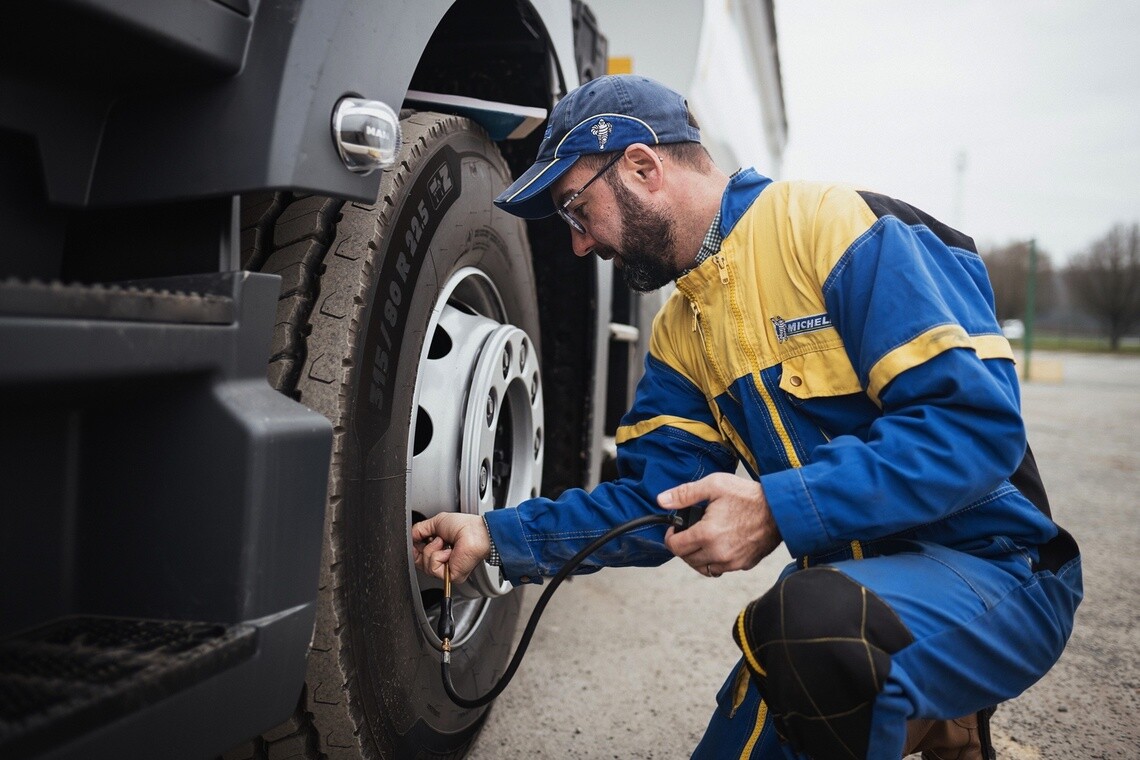
checking tire pressure
Tire pressure should be checked as part of a consistent maintenance process, not only when a tire appears low. Because operating conditions can affect pressure readings, following a consistent procedure helps fleets compare tire pressure against their established inflation specifications.
How often should tire pressure be checked? Inspection frequency can depend on the fleet's maintenance program, application and operating conditions. Michelin's recommended North American inspection frequency should be confirmed before establishing a specific interval.
Tire pressure should be checked as part of a consistent maintenance process, not only when a tire appears low. Because operating conditions can affect pressure readings, following a consistent procedure helps fleets compare tire pressure against their established inflation specifications.
How often should tire pressure be checked? Inspection frequency can depend on the fleet's maintenance program, application and operating conditions. Michelin's recommended North American inspection frequency should be confirmed before establishing a specific interval.
A practical pressure-check process includes:
- Check pressure when tires are cold. Driving generates heat, which can increase inflation pressure and make a warm reading different from the cold inflation pressure.
- Use an appropriate, calibrated pressure gauge. Accurate measurements are important when comparing actual tire pressure with the fleet's established specification.
- Check every tire position. A visual inspection alone cannot reliably determine whether a tire is properly inflated.
- Compare the reading with the established cold inflation specification. If pressure is outside the fleet's specification, follow the appropriate maintenance procedure before returning the tire to service.
- Inspect the valve and valve cap. Look for signs of damage or potential air loss.
- Investigate recurring pressure loss. If a tire repeatedly loses pressure, identify the cause rather than continually adding air. We'll explain common causes of recurring pressure loss below.
If you have any doubt, discover all our technical guidelines in michelin databook.
Common Causes of Recurring Truck Tire Pressure Loss
A tire that repeatedly loses pressure needs more than another top-off. Identifying the source of the pressure loss can help prevent the same issue from recurring and give maintenance teams a clearer picture of tire and wheel condition.
Common sources of pressure loss can include:
- Tire damage or punctures: Damage to the tire can create a path for air to escape.
- Natural pressure loss through tire components: Some pressure loss can occur gradually over time.
- Valve or valve-to-rim leaks: The valve mechanism or its connection to the rim can be a source of air loss.
- Tire bead and rim interface: Air can also escape where the tire bead and rim meet.
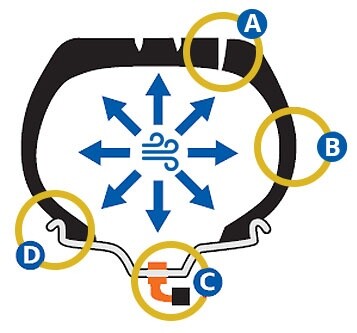
four possible reasons for a loss of truck tyre pressure
A- Tire damage or puncture
B- Natural pressure loss through tire components
C- Valve or valve-to-rim air loss
D- Air loss at the tire bead and rim
Make Tire Pressure Part of Your Fleet Maintenance Strategy
Proper tire inflation works best as part of a consistent tire management program. Establishing inflation specifications for the application, checking pressure routinely and addressing recurring pressure loss can help fleets manage tire condition throughout the tire lifecycle.
For fleets, the goal is consistency. A defined approach to pressure management can help support tire performance, maintenance predictability and long-term tire value.
Need commercial tire service or support?
Find a Michelin Commercial Service Network provider
Need more advice? Discover all Michelin truck tire tips
Frequently Asked Questions About Commercial Truck Tire Pressure
There is no single PSI that applies to every commercial truck tire. Appropriate inflation pressure depends on factors such as the tire size, load, axle position and configuration. Use the tire manufacturer’s load-and-inflation guidance to determine the appropriate cold inflation pressure for the application.
Yes. Tire pressure should be checked when tires are cold because driving generates heat that increases inflation pressure. Checking cold pressure provides a consistent baseline for comparing the reading with the fleet’s established inflation specification.
Yes. Underinflation can increase rolling resistance, which may contribute to increased fuel consumption. The actual impact can vary based on factors such as the degree of underinflation, tire, vehicle and operating conditions.
Not necessarily. The maximum pressure marked on a tire should not automatically be treated as the appropriate operating pressure for every application. Operating pressure should be established using the tire manufacturer’s guidance and the load and application requirements.
Recurring pressure loss can have several causes, including tire damage or punctures, gradual pressure loss through tire components, valve or valve-to-rim leaks, and air loss at the tire bead and rim. If a tire repeatedly falls below its established inflation specification, the tire and wheel assembly should be inspected to identify the source.


